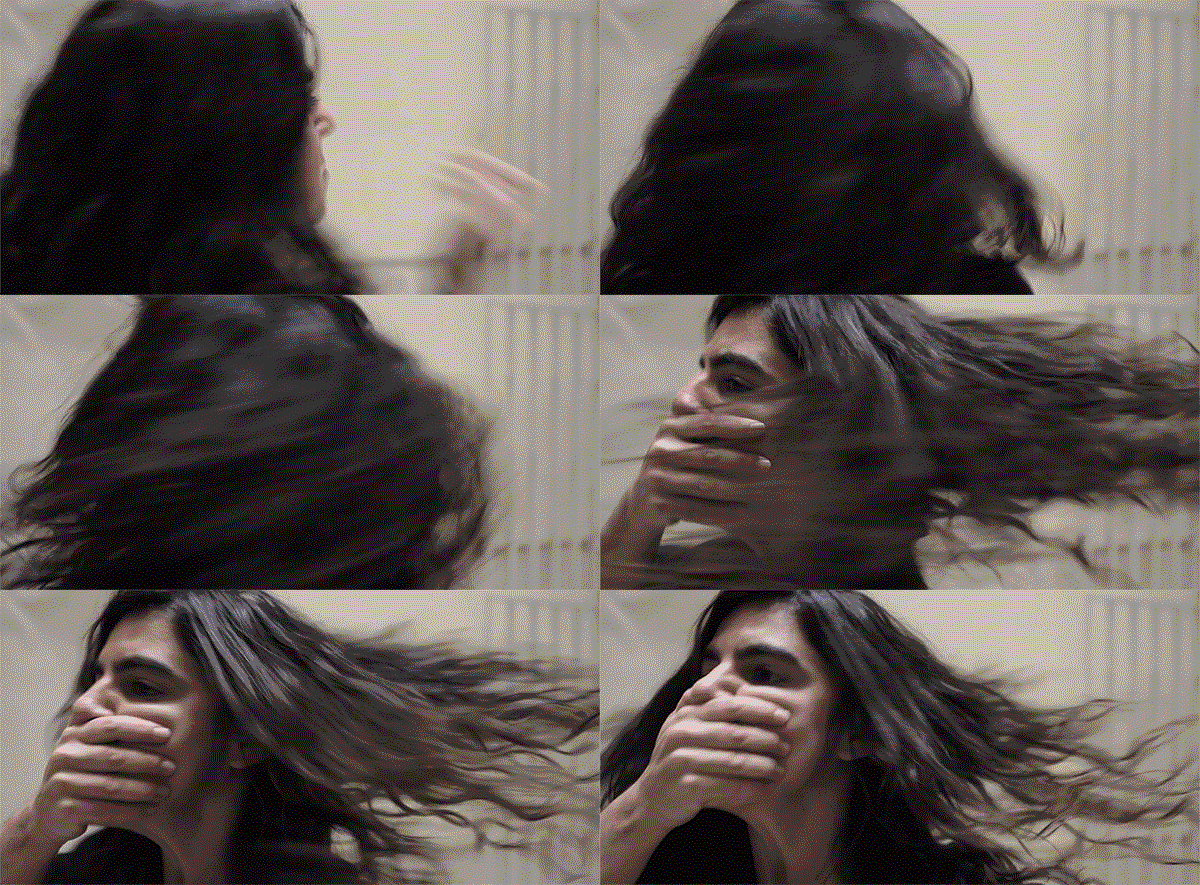
Joana Chicau is a media designer, researcher and performer - with a background in classical & contemporary dance - currently based in The Netherlands. She runs a transdisciplinary research project which interweaves media design and web environments with performance and choreographic practices. Chicau has been actively participating in debates and performative international events; and the project has been grown into diverse formats.
Anxious to Make is the collaborative practice of Liat Berdugo and Emily Martinez, two commissioning bodies. Our focus is on the so-called "sharing economy" and the contemporary artists "anxiety to make" in the accelerationist, neoliberal economic landscape. While Anxious to Make’s physical existence takes many shifting forms, it often manifests as series of video commissions, downloads, online generators, workshops, net art interventions, and sweepstakes. Anxious to Make believes in absurdist extremes as way to examine contemporary realities. Our work has appeared recently in EMMEDIA (Calgary, CA), Transmediale (Berlin, DE), Yerba Buena Center for the Arts (San Francisco), MoMA PS1 (New York), V2_ Institute for the Unstable Media (Rotterdam, NL), and The Luminary (St. Louis, MO).
Liat Berdugo is an artist, writer, and curator based in Oakland, CA. Her work strives to create an expanded, thoughtful consideration for new media and digital culture. Berdugo has been exhibited in galleries and festivals internationally, and she collaborates widely with individuals and archives. She is the co-founder of World Wide West, co-founder of the Living Room Light Exchange, and Net Art and Special Programs Curator for Israel’s Print Screen Festival. Her writing appears in Rhizome, Temporary Art Review, and HZ Journal. Berdugo holds a B.A. in mathematics and philosophy from Brown University and an M.F.A. in digital + media from the Rhode Island School of Design. She is currently an assistant professor of Art and Architecture at the University of San Francisco.
Emily Martinez is a new media artist, designer, and digital strategist based in Los Angeles, CA. Her current art practice and research interests center around issues of economic justice and digital labor. Recent works consider: subjectivity and cooperation under platform capitalism; class struggle in the age of the algorithm; the ambiguous politics of Open Source culture; artistic entrepreneurship as a critical framework; and speculative business model design methodologies for a post-capitalist future.
Niko Princen (nl, 1979) studied art at Hogeschool van de Kunsten Utrecht and at the The School of the Art Institute of Chicago. His practice concentrates around the internet, wherein the human interaction and (mis)communication through the computer play a role. Princen works in front of the screen as well as behind, sometimes blending the two together. He also looks at the online public lives of his peers and searches for the true 'connectivity of people'. Princen's works has been shown internationally at venues like Kunsthaus Langenthal, Switzerland, The Future Gallery, Berlin and the Museum of the Moving Image, New York.
The dstet.zone is an international collective. They do it, but they do it better. More info at: dstet.zone/nervous
Matthew de Kersaint Giraudeau creates sculptures, drawings, performances and videos. His work is about ugliness, abjection and the ambiguities of language and objects.
Matthew de Kersaint Giraudeau was an Associate of Open School East, 2013-2014. He runs The Bad Vibes Club, which is a forum for research into negative states, runs Radio Anti with Ross Jardine, and collaborates with Ben Jeans Houghton as the ARKA group. He lives and works in London.
Daniel Pinheiro. Born in Venezuela. Currently lives and works from Portugal. Graduated in Theater also developed his skills in the fields of Video Editing, Media, Performance Art and Networked Performance. As an independent artist and researcher his work bounces between the experimentation with video and how it transforms the perception of the self through different techniques. Since 2011 his work has greatly focused on the Internet as a medium and video as format to mediate communication and emulate presence. Although video itself and the editing process are essential tools to operate and produce video works that fall on categories such as video and queer art, it also serves an essential purpose that is to have the “camera” as a spectator of actions
on archiving movement resulted from participating in "Watching-watching: memory, embodiment and story" by choreographer Bebe Miller at Taking Place, as part of the Meta-Academy project at ImPulsTanz 2014. Reflecting on Miller's audio recording, collaborators were invited to perform their own version of Watching-watching while investigating notions of direct mediated movement transmission as a generative space. on archiving movement is a repetition, a re-enactment of self through its own meditation, gradually becoming a continuous stream; a body enacting it's own return framed by the context of where it stands.
…the political-ethical imperative for re-enactments not only to reinvent, not only to point out that the present is different from the past, but to invent, to create— become of returning—something that is new and yet participates fully in the virtual cloud surrounding the originating work itself—while bypassing an author’s wishes as last words over a work’s destiny. This is one of the political acts re-enacting performs as re-enactment: it suspends economies of authoritative authors who want to keep their works under house arrest. To re-enact would mean to disseminate, to spill without expecting a return or a profit. It would mean to expel, to ex-propriate, to excorporate under the name of a promise called giving. In other words, reenactments enact the promise of the end of economy. They make dance return, only to give it away. (Lepecki 2010, 35) [source]
Aya Bentur is a designer currently based in Tel Aviv, researching the interface of the physical and virtual through body gestures. She is a partner and designer at Reforma Eyewear and writes about design processes. Bentur holds a BA in Jewellery from Bezalel Academy of Art and Design and an MA in Social Design from the Design Academy Eindhoven. She is a co-founder of Fictional Collective.
Bili Regev iis a multidisciplinary designer, specializing in service design and UX architecture, currently working on strategic projects involving human centric approach. She researches human interaction between people services and technology in order to find innovative responses to people's daily pain points. Bili is a graduate of the Design Academy Eindhoven Man and Well-Being department, and a member of Fictional Collective.
Jane Frances Dunlop (CA/UK) is an artist and writer whose work addresses emotion and performances of relation on the Internet. Recent works include speculative and palimpsestic, a performance within Documents of the Future at ACMI’s Channel Festival (Melbourne, AUS) and CRTL+SHFT Collective (San Francisco, USA) and slow rhyme for an echo, part of the exhibition Andere Geschichte(n) at Künstlerhaus (Vienna, AU). She has written essays on nervousness as well as telegraphs for Real Life. She lives and works in London, UK.
Elizabeth Mputu is a Florida native of Congolese descent. They studied Performance Art at the School of the Art Institute of Chicago, and prior to that they attended DePaul University. Their work mostly focuses on the artist's ability to grapple with sexuality, gender, the taboo, health, healing and African spirituality filtered through the performative and digital medium. They hope the findings of their investigations, as defined by the multi-dimensional and biographical pieces they create whether by video, web or physical will be considered THOTful contributions to the archive of the human condition.
Jordana Bragg is a contemporary multidisciplinary artist currently based in Te Whanganui-a-Tara Wellington, Aotearoa New Zealand. Co-founder of the artist run initiatives Meanwhile (NZ) and Friends are Artists/Freunde sind Künstler (DE), Bragg's independent practice spans curation, written form, live performance, still and moving image. Each work documenting contemporary shifts in fluidity - gender and identity politics.
Colm O'Neill is a designer and researcher based in Rotterdam and Brussels. His work is concerned with mediations of digital literacy through graphical, user and programmatic interfaces. The research and practice that result follow the ideals of free and open source development models.
Scrolling is an achievement! Be proud of your metrics! How can we grasp physical world units on screens? How can I print a centimeter on the screen. How can I make sure the centimeter will remain a centimeter across all types of screens?
We know screens are just grids of pixels, but what is less easy is to find out how many pixels are on the panel. If you know the physical measurements of the screen, and the screen resolution in pixels, then we can work out the pixel density. Reminiscents of the print world call this number PPI, points per inch, in this case pixels per inch, effectively the same notion. pixels per inch
If we know a screen's PPI, (in my case I'll rather a PP-centimeter) we can make rules to draw and display real centimeters. Keep in mind that this won't ever be perfectly precise, grids of pixels in pannels don't constrain to a rhythmical finish, and we can't exactly turn halfs or quarter pixels on or off.
download as a webextensionmore adversarial interfaces